The core pretraining design of Voxtral (Mistral, 2025): how to introduce speech to a
text LLM from cheap (audio, transcript) data. An audio–text corpus is segmented (via VAD +
diarization; transcripts ASR-pseudo-labeled when missing) into pairs
(A₁,T₁), (A₂,T₂), …, (Aₙ,Tₙ), then woven into training samples by two patterns (following
Spirit-LM / Zeng et al.):
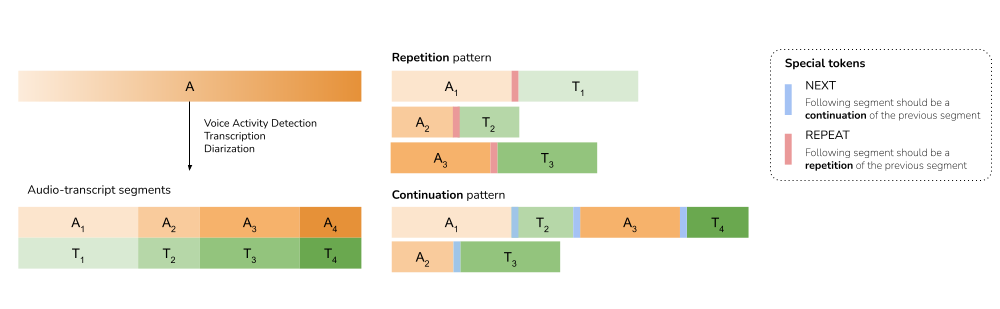
Figure 2 — Pretraining patterns. A segment is split into
(Aₙ,Tₙ)pairs. Repetition: audioAₙis followed by its own transcriptTₙ, signaled by<repeat>. Continuation: audioAₙis followed by the next segment’s textTₙ₊₁, signaled by<next>.
| Pattern | Sample form | Special token | Teaches |
|---|---|---|---|
| Audio-to-text repetition | (Aₙ, Tₙ) — audio then its own transcript | <repeat> | explicit speech→text alignment (mimics ASR) → transcription |
| Cross-modal continuation | (A₁, T₂, A₃, T₄, …) — each audio followed by the next segment’s text | <next> | modality-invariant context modeling (resembles QA / dialogue) → understanding |
Because the text following an audio segment is ambiguous (repeat vs continue both valid), the
<repeat> / <next> tokens disambiguate during training and steer behavior at inference.
Each pair is a standalone <bos>…<eos> sequence (no prior context). Text-only data is mixed in
to preserve the decoder’s text ability.
Why both — the 50/50 result
The two patterns are complementary and both necessary (Voxtral §5.3, Fig 9):
- Repetition only → strong ASR, but ~0% on Llama QA (no understanding).
- Continuation only → strong Llama QA, but ~60% WER on ASR (can’t transcribe).
- Balanced 50/50 → recovers both ASR and QA to near single-pattern levels.
So transcription and understanding are separable capabilities induced by different data
framings, and a single token (<repeat>/<next>) lets one model toggle between them.
Relation to the rest of the wiki
- This is Voxtral’s answer to the text↔audio coupling problem that every speech-LLM faces. Compare Moshi’s Inner Monologue (time-aligned text tokens as a prefix to audio, in the same stream) — a different mechanism for the same goal of grounding audio in text. Inner Monologue interleaves at the token/timestep level; Voxtral’s patterns interleave at the segment level with explicit task tokens.
- Both rely on ASR pseudo-labeling to turn untranscribed audio into supervision.
Source: Voxtral (Mistral paper).