The streaming neural audio codec that tokenizes audio for Moshi. Mimi is the piece that makes real-time speech-to-speech possible: it turns 24 kHz waveforms into discrete tokens a language model can predict, and back, causally (low-latency, streaming).
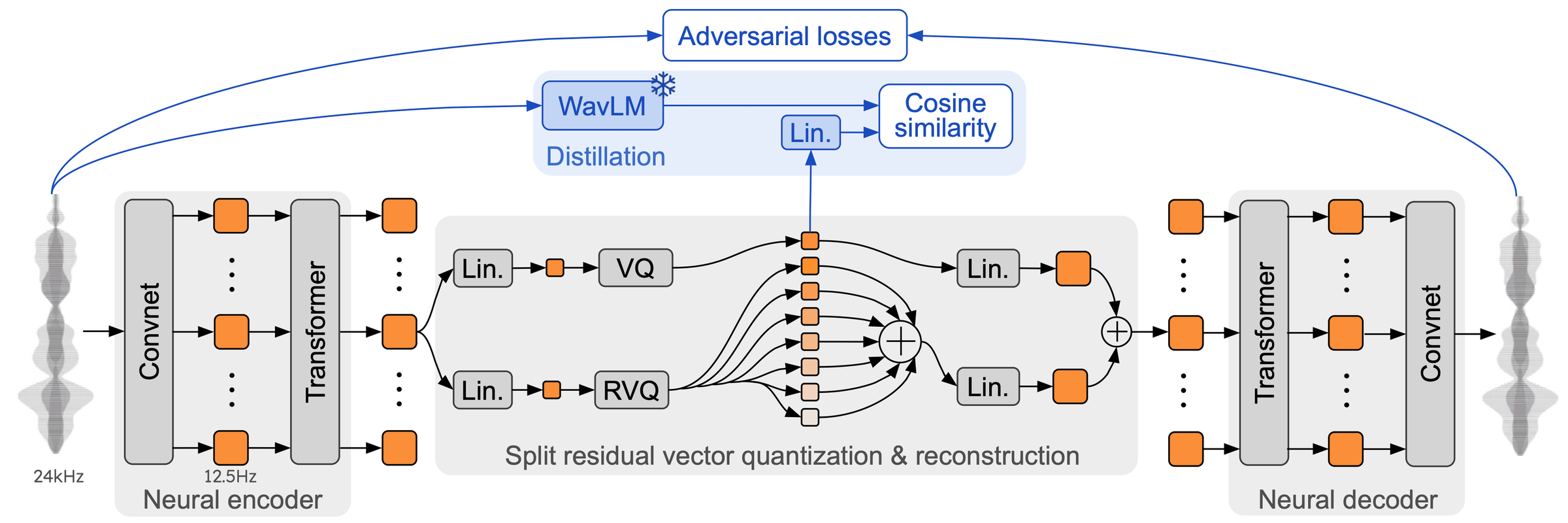
Figure 2 — Mimi’s SeaNet encoder/decoder with a Transformer bottleneck and split RVQ: a semantic VQ (distilled from a frozen WavLM via cosine similarity) in parallel with a 7-level acoustic RVQ, trained with adversarial losses.
Key specs
- 24 kHz input → latent at 12.5 frames/sec, dim 512 (SeaNet conv autoencoder, all causal convolutions; 80 ms frame size and stride).
- Residual Vector Quantization (RVQ): Q = 8 quantizers, codebook size 2048 → 1.1 kbps.
- Transformer bottleneck (8 layers, causal) before and after quantization for quality.
- Adversarial-only training (feature + discriminator loss, no reconstruction loss) — a counter-intuitive but large subjective quality win.
- Quantizer dropout for bitrate scalability; quantization applied only 50% of the time during training (improves quality, more so at low bitrate).
Split RVQ — fusing semantic + acoustic tokens
Audio LMs usually need semantic tokens (linguistic, from a self-supervised model) and acoustic tokens (high-fidelity reconstruction). Computing both separately is non-causal and expensive. Mimi instead distills non-causal WavLM embeddings into its tokens via a split RVQ: a single semantic VQ in parallel with a 7-level acoustic RVQ, summed. This avoids forcing acoustic detail into the residual of the semantic quantizer, giving a better semantic/acoustic trade-off while staying streaming-compatible.
Why it matters
Mimi is the Moshi design choice that most directly contrasts with TML’s Encoder-Free Early Fusion: Moshi commits to a learned discrete codec (tokenizer + detokenizer), whereas TML-Interaction-Small avoids standalone codecs/encoders and feeds minimally-preprocessed signals (dMel/hMLP) co-trained from scratch. Same problem (real-time multimodal I/O), opposite bet on tokenization.
Source: Moshi (Kyutai paper).