The multimodal input/output design of TML-Interaction-Small. Rather than routing audio and video through large standalone encoders/decoders (e.g. a Whisper-like encoder or a separate TTS model), it uses minimal preprocessing with all components co-trained from scratch alongside the transformer:
| Modality | Handling |
|---|---|
| Audio in | dMel representation → lightweight embedding layer |
| Image/video in | split into 40×40 patches, encoded by an hMLP |
| Audio out | flow head (flow-matching decoder) |
| Text | standard embedding / unembedding |
Each 200ms micro-turn the model takes any subset of {text, audio, frame} and predicts text and mel. Co-training avoids the quality/latency overhead and modularity seams of bolt-on encoders, fitting the “interactivity is part of the model” thesis of Interaction Models.
Figure — single-micro-turn architecture (source Fig. 4)
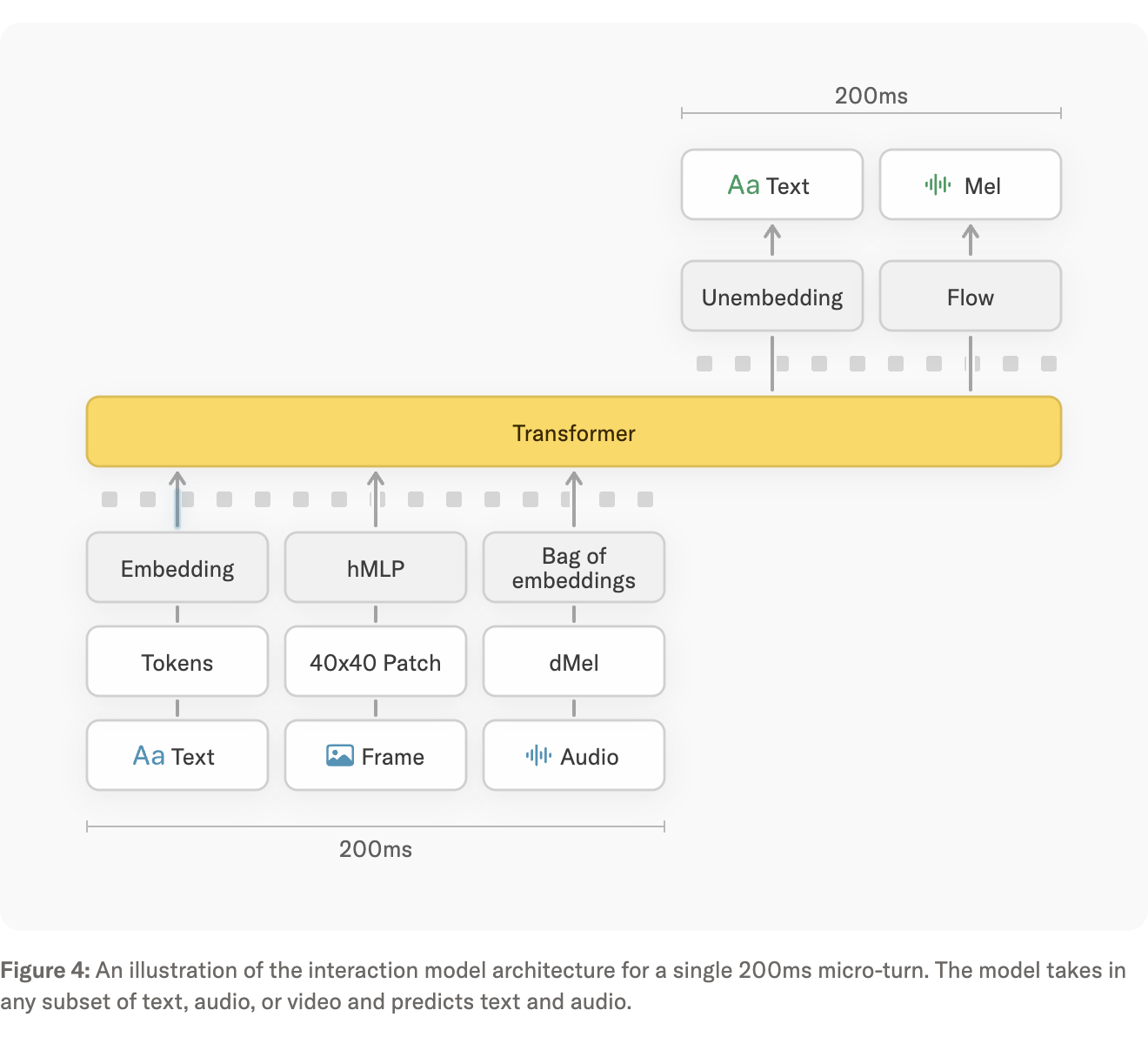
An illustration of the interaction model architecture for a single 200ms micro-turn. The model takes in any subset of text, audio, or video and predicts text and audio.
Contrast: codec-based tokenization (Moshi)
The opposite design bet is Moshi’s Mimi codec: a learned discrete tokenizer/detokenizer (RVQ) that audio is routed through. TML deliberately avoids such standalone encoders/decoders, feeding minimally-preprocessed signals co-trained from scratch. Both target real-time multimodal I/O; they disagree on whether to commit to a codec. See Moshi (Kyutai paper).
Contrast: encoder + adapter (Voxtral)
The third design point is Voxtral (Mistral), which does exactly what TML avoids: a large standalone Whisper large-v3 encoder (640M, pretrained ASR) feeding a downsampling adapter into a frozen-ish Mistral LLM. This is the encoder-based end of the spectrum — mature, off-the-shelf audio features at the cost of the modularity seams and the encoder’s fixed 30 s receptive field. Three bets on getting audio into a transformer: encoder+adapter (Voxtral) · codec (Moshi/Mimi) · encoder-free co-training (TML). Note Voxtral is understanding-only (audio→text), so it can afford a heavy batch encoder where the real-time models cannot. See Speech Understanding.
Source: Interaction Models (TML blog).