The hierarchical, streaming architecture Moshi uses to model many interleaved token sub-streams per timestep. It factorizes generation into two Transformers:
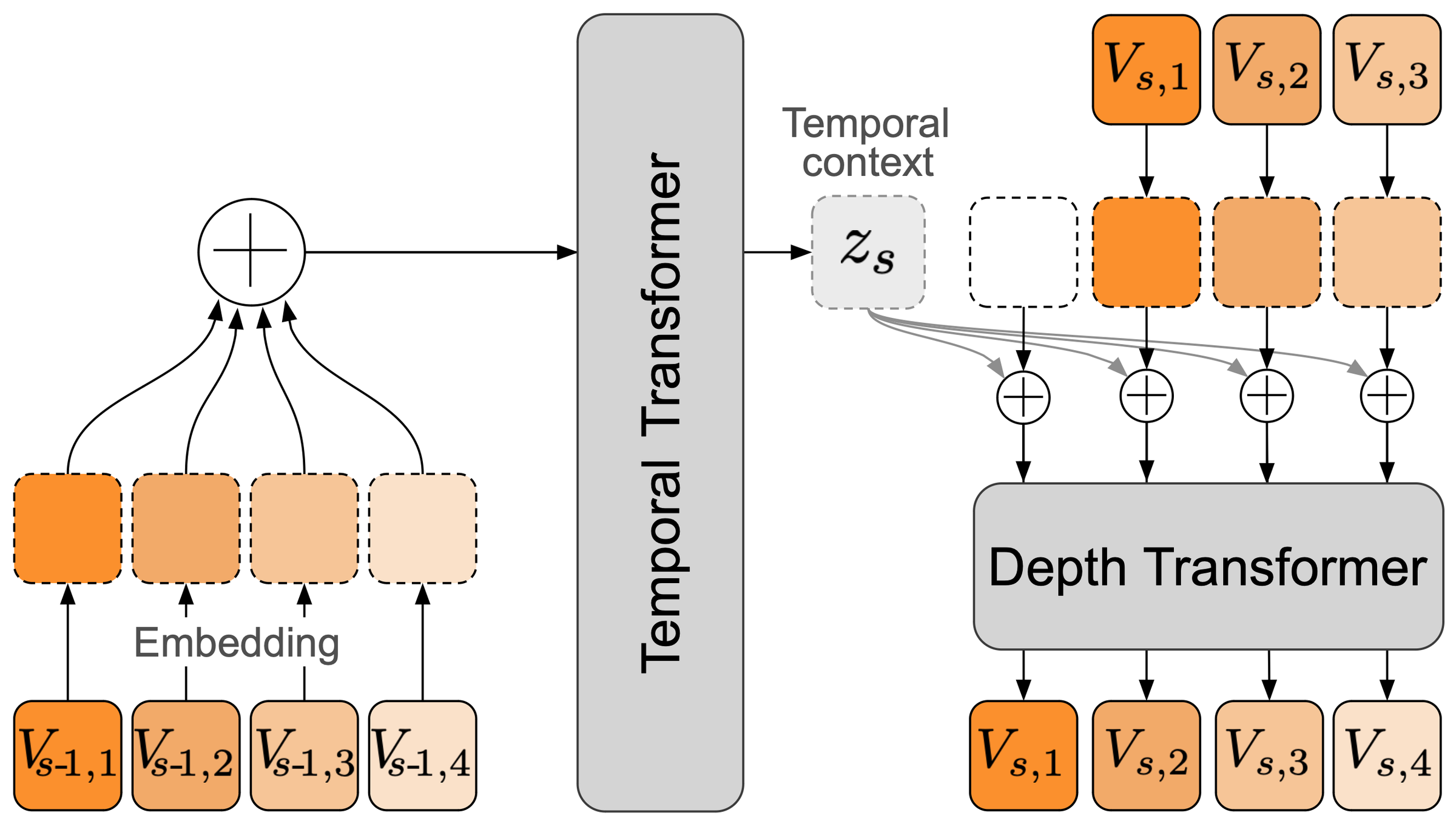
Figure 3 — The RQ-Transformer breaks a flattened length-K·S sequence into S timesteps for a large Temporal Transformer (producing a context embedding
z_s) that conditions a smaller Depth Transformer over the K sub-streams. (K = 4 shown for illustration.)
- Temporal Transformer — the large model, runs across time steps (one step = 80 ms / one Mimi frame). Initialized from Helium.
- Depth Transformer — a small model (dim 1024, 6 layers) that runs across the sub-streams within a single step (the K codebooks/text), predicting them bottom-to-top.
This split lets one big model capture long-range temporal structure while a cheap inner model resolves the per-step codebook hierarchy — keeping the whole thing streaming-capable.
Notable design choices
- Per-codebook parameters in the Depth Transformer.
- Acoustic delay — offsetting acoustic tokens by 1–2 steps behind semantic tokens reduces inter-codebook dependence at a step and markedly improves generation stability/quality.
- Generates semantic and acoustic tokens jointly in a streaming fashion (vs prior work that produced all semantic tokens first), and extends naturally to the multi-stream + Inner Monologue joint sequence (K = 17 sub-streams).
Source: Moshi (Kyutai paper).