A natively end-to-end omni-modal model by Qwen Team (Sept 2025) that takes text, image, audio, and video in and produces streaming text or speech out. The flagship is Qwen3-Omni-30B-A3B (a Mixture-of-Experts model, 30B total / 3B active). Source: Qwen3-Omni (technical report).
Its central claim is non-degradation: with joint multimodal training (mixing unimodal + cross-modal data early in text pretraining), it matches same-size unimodal Qwen text and vision models while adding strong audio — no modality tax. Across 36 audio / audio-visual benchmarks it reports open-source SOTA on 32 and overall SOTA on 22.
For this wiki’s focus it belongs to the Real-Time Interactive Speech Models cluster alongside Moshi and Interaction Models — but unlike them it is omni-modal, and unlike the understanding-only Voxtral it both understands and generates speech.
Architecture — Thinker-Talker Architecture
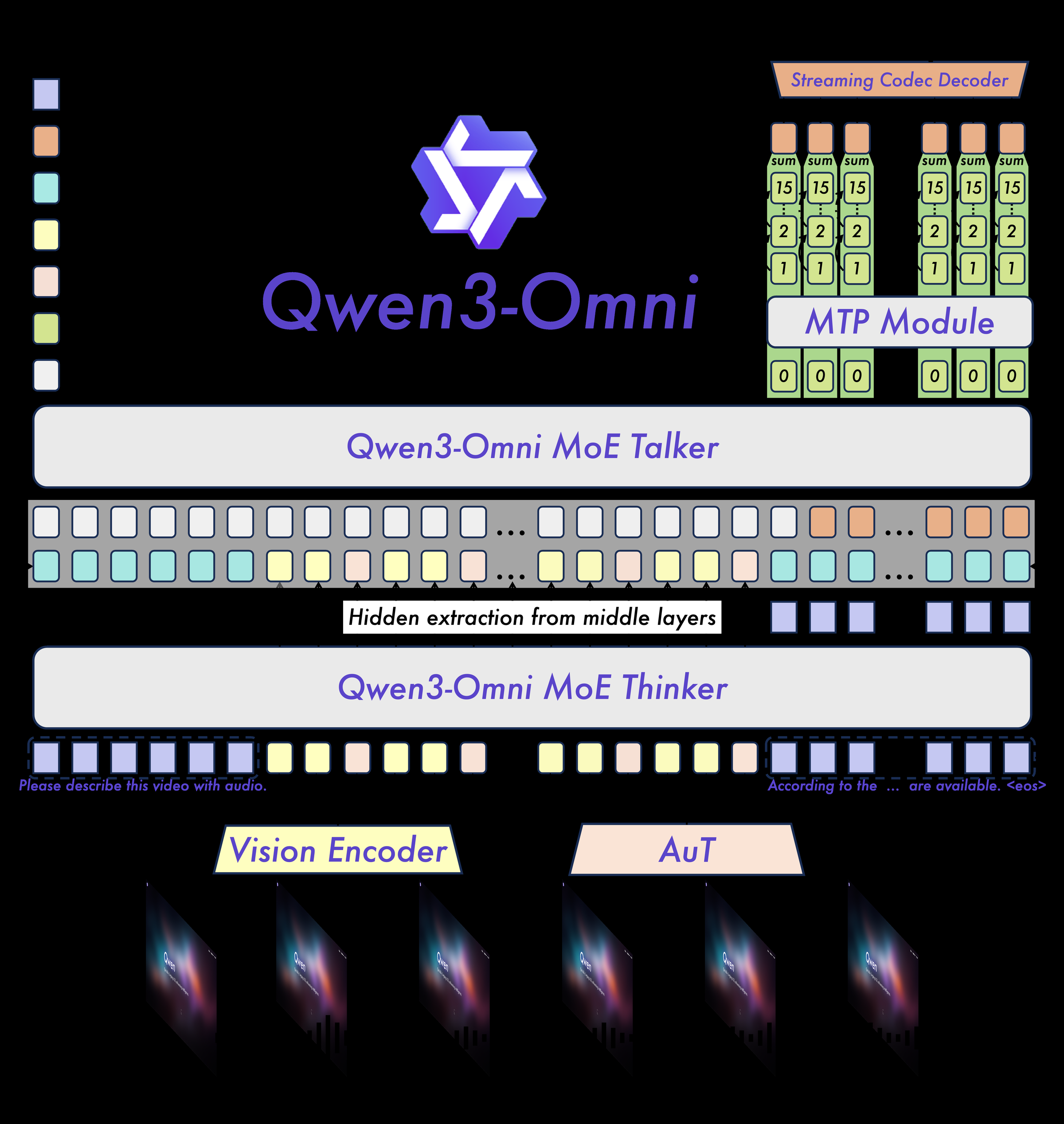
Figure 2 — Qwen3-Omni’s Thinker-Talker architecture. The Thinker generates text; the Talker generates streaming speech tokens from the Thinker’s multimodal representations. The Talker autoregressively predicts a multi-codebook sequence; per step an MTP module emits the residual codebooks and Code2Wav incrementally renders the waveform, frame-by-frame.
Component sizes (30B-A3B):
| Module | Architecture | Params | Streaming |
|---|---|---|---|
| Audio encoder | AuT (Audio Transformer) | 650M | ✓ |
| Vision encoder | SigLIP2-So400M | 540M | – |
| Thinker | MoE Transformer | 30B-A3B | ✓ |
| Talker | MoE Transformer | 3B-A0.3B | ✓ |
| MTP | Dense Transformer | 80M | ✓ |
| Code2Wav | ConvNet | 200M | ✓ |
End-to-end first-packet latency: 234 ms (audio) / 547 ms (audio-video).
Audio path (input → understanding)
- Audio is resampled to 16 kHz → 128-channel mel-spectrogram (25 ms window, 10 ms hop) → AuT (Audio Transformer) encoder → tokens at 12.5 Hz (~80 ms per frame).
- Position handled by TM-RoPE (Time-aligned Multimodal RoPE): temporal/height/width angles split 24/20/20; audio gets one temporal ID per 80 ms, anchored to absolute time so audiovisual streams of arbitrary length align without the fixed 2-second chunking used in Qwen2.5-Omni.
- Handles audio > 40 minutes; 19 spoken languages understood.
Speech generation (Talker)
- The Talker conditions on the Thinker’s multimodal features but not its text representations (discrete text tokens ≈ embeddings; decoupling lets external modules — RAG, function-calling, safety — intervene on text before synthesis).
- Operates directly on RVQ (multi-codebook) tokens: backbone predicts codebook 0 via a linear head; an MTP module predicts all residual codebooks for the frame.
- Code2Wav is a lightweight causal ConvNet vocoder (replaces the block-wise DiT of Qwen2.5-Omni) → lower latency/FLOPs, single-frame immediate synthesis at 12.5 Hz.
- 10 spoken languages for generation; multi-codebook representation targets diverse voices and paralinguistic cues.
Upgrades over Qwen2.5-Omni
Thinker & Talker → MoE; Whisper → AuT (Audio Transformer); single-track → multi-track multi-codebook codec with MTP; DiT vocoder → Code2Wav ConvNet; input/output rates → 12.5 Hz with single-frame synthesis; plus long-audio (>40 min), 119 written languages, a Thinking (reasoning) variant, and ~234 ms streaming latency.
See also
- AuT (Audio Transformer) · Thinker-Talker Architecture
- Real-Time Interactive Speech Models — where it sits vs Moshi / Interaction Models / Voxtral
- Contrasts: Multi-Stream Audio Modeling & Inner Monologue (Moshi), Speech Understanding (Voxtral)