A pair of open-weights (Apache 2.0) multimodal audio-chat models by Mistral AI (July 2025): Voxtral Mini (4.7B) and Voxtral Small (24.3B). Voxtral takes spoken audio and text in, and produces text out — it comprehends audio (transcribe, translate, answer questions, summarize, call functions) rather than generating speech. State-of-the-art on transcription/translation among open and closed models in its price class, while preserving the text ability of its LLM backbone. A 32K context window handles audio up to ~40 minutes.
This makes Voxtral a different class of model from the wiki’s full-duplex dialogue cluster (Moshi, Interaction Models): it is a Speech Understanding model (audio→text), not a real-time speech-to-speech system. See Speech Understanding for the paradigm contrast.
Architecture
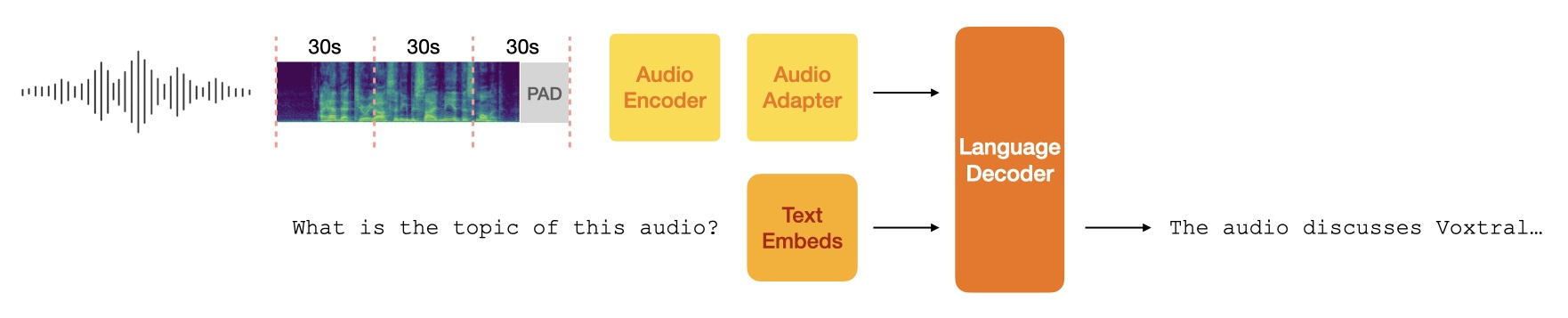
Figure 1 — Voxtral Architecture. The audio encoder attends to 30-second chunks of audio independently; the embeddings are concatenated and downsampled 4× in the audio-language adapter; the multimodal LLM decoder auto-regressively predicts text, conditioned on audio + text inputs.
Three components, a conventional encoder → adapter → decoder cascade — the opposite design bet to TML’s Encoder-Free Early Fusion:
- Audio encoder — Whisper large-v3 (640M). Raw waveform → 128-bin log-Mel spectrogram (160 hop) → conv stem (2× temporal downsample) → bidirectional self-attention → 50 Hz audio embeddings. Whisper’s fixed 30-second receptive field is handled by encoding each 30 s chunk independently (positional encodings reset per chunk, chunks batched) — functionally chunk-wise attention, which controls cost and improves length generalization. Short audio is padded to 30 s (the padding ablation kept this).
- Audio-language adapter — an MLP that downsamples 4× (50 Hz → 12.5 Hz), cutting the decoder sequence length. At 12.5 Hz a 30-min audio is ~22.5K tokens instead of 90K. (Note: the same 12.5 Hz rate Moshi’s Mimi codec lands on — Voxtral argues each audio embedding then carries ≈ one text-embedding’s worth of information.)
- Language decoder — a Mistral LLM. Mini = Ministral 3B (edge-focused); Small = Mistral Small 3.1 24B. Audio is injected as embeddings; the decoder outputs text.
Parameter counts (Table 1)
| Variant | Audio Encoder | Audio Adapter | Text Embeddings | Language Decoder | Total |
|---|---|---|---|---|---|
| Mini | 640M | 25M | 400M | 3.6B | 4.7B |
| Small | 640M | 52M | 670M | 22.9B | 24.3B |
Training
Three phases — see Audio-Text Pretraining Patterns for the pretraining design, the key contribution.
- Pretraining — introduce speech to the text decoder. Audio is chunked into
(audio, transcript)pairs (boundaries from VAD + diarization; missing transcripts are ASR pseudo-labeled). Two interleaving patterns sampled 50/50 — audio-to-text repetition (<repeat>, drives transcription) and cross-modal continuation (<next>, drives understanding) — plus text-only data to keep text skills. First pass freezes encoder + decoder, trains only the adapter (a warm-up that helps understanding evals). Voxtral Mini Transcribe is a repetition-only ASR variant. - Supervised finetuning (SFT) — mostly synthetic: long-form transcripts → Mistral Large generates QA / summarization / translation pairs framed as if from listening; text SFT (incl. function-calling) → converted to audio via TTS; real ASR questions answerable from world knowledge → paired with Mistral-Large answers (to fix TTS-only’s poor generalization to real, accented speech). A special “transcribe mode” token removes the need for a text prompt on pure ASR.
- Preference alignment — DPO and Online DPO. Clever trick: responses are ranked by a text reward model fed the audio’s transcription (semantics/style/coherence transfer). Online DPO reused the Magistral sampling/reward infra.
Results
State-of-the-art transcription + translation; competitive with GPT-4o mini / Gemini 2.5 Flash on understanding.
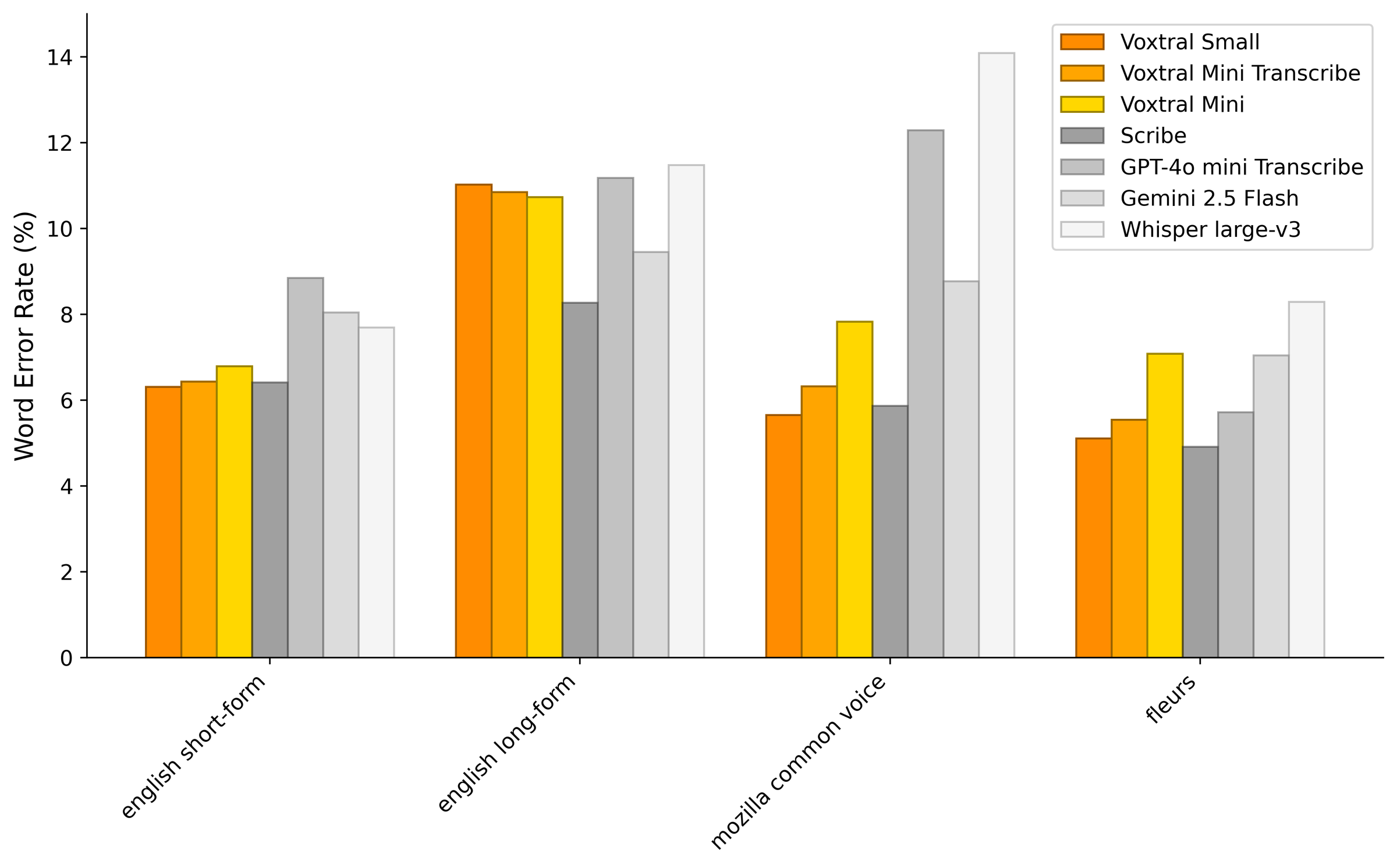
Figure 3 — Speech Recognition (macro-avg WER ↓). Voxtral Small beats all open & closed models on English Short-Form and MCV; Voxtral Mini Transcribe beats GPT-4o mini Transcribe and Gemini 2.5 Flash on every task.
- Speech recognition (WER ↓): Voxtral Small is SOTA on English Short-Form & MCV. Voxtral Mini Transcribe beats GPT-4o mini Transcribe and Gemini 2.5 Flash across all four task groups — while being a 4.7B model. (Per-task / per-language: Tables 3–6 in Voxtral (Mistral paper).)
- Speech translation (BLEU ↑, FLEURS): Voxtral Small is SOTA on every source/target pair tested, beating GPT-4o mini Audio and Gemini 2.5 Flash.
- Speech understanding (Table 8): competitive with closed models; Voxtral Small beats GPT-4o mini Audio on 3 of 7 tasks.
- Text-only: Voxtral Small matches Mistral Small 3.1 across five text benchmarks — a drop-in replacement for both text and audio, i.e. audio is added without a text tax.
Speech understanding accuracy (Table 8, %)
| Model | Llama QA | Openbook QA | MMLU* | MMAU* | Trivia QA* | GSM8k* | AU Bench |
|---|---|---|---|---|---|---|---|
| GPT-4o mini Audio | 74.3 | 83.7 | 72.6 | 63.4 | 83.7 | 90.8 | 80.0 |
| Gemini 2.5 Flash | 66.3 | 94.7 | 84.8 | 64.3 | 83.9 | 94.2 | 88.6 |
| Voxtral Mini | 54.3 | 59.6 | 47.6 | 57.1 | 54.9 | 71.6 | 85.6 |
| Voxtral Small | 71.7 | 88.4 | 74.3 | 62.2 | 79.4 | 89.7 | 86.6 |
* = speech-synthesized subset of a text benchmark (Voxtral’s contributed evals). AU Bench =
the in-house Speech Understanding benchmark.
Speech translation (Table 7, FLEURS BLEU ↑)
| Model | en→de | en→es | en→fr | en→it | de→en | es→en | fr→en | it→en |
|---|---|---|---|---|---|---|---|---|
| Whisper large-v3 | – | – | – | – | 46.1 | 34.9 | 43.0 | 35.7 |
| GPT-4o mini Audio | 44.5 | 36.5 | 52.7 | 37.3 | 51.8 | 41.6 | 48.2 | 41.5 |
| Gemini 2.5 Flash | 44.6 | 36.3 | 53.9 | 37.3 | 39.4 | 32.9 | 42.0 | 31.8 |
| Voxtral Small | 47.0 | 39.9 | 57.3 | 39.9 | 56.6 | 46.3 | 54.2 | 46.8 |
Contributed benchmarks
To address the field’s thin understanding-evals, Voxtral releases speech-synthesized versions of GSM8K, TriviaQA, and MMLU (text benchmarks filtered to “verbalizable” prompts, TTS’d with varied speakers) plus an internal Speech Understanding (SU) benchmark (≤19-min audios, LLM-judge binary helpfulness + 0–5 grade). Released under a permissive license.
Ablations (highlights)
See Voxtral (Mistral paper) for the figures.
- To pad or not to pad (§5.1): removing Whisper’s 30 s padding gives ~no FLEURS-en penalty but 0.5% WER worse on French → keep padding.
- Adapter downsampling (§5.2): 12.5 Hz (4×) is the sweet spot — little ASR loss vs 50 Hz, and Llama QA actually +1.5% over the 50 Hz baseline; 6.25 Hz (8×) costs >1% WER. Hypothesis: at 12.5 Hz an audio embedding ≈ a text embedding’s information content.
- Pretrain patterns (§5.3): repetition-only → strong ASR but ~0 on Llama QA; continuation-only → strong QA but ~60% WER; 50/50 recovers both. → Audio-Text Pretraining Patterns.
- Online DPO (§5.4, Table 2): improves SU response quality for both sizes; shipped as the default Mini checkpoint; Small default stays SFT (Online DPO slightly regressed English short-form WER).
Relation to the rest of the wiki
- Different paradigm from Moshi / Interaction Models. Those are real-time full-duplex speech↔speech; Voxtral is audio→text understanding (no speech output, not real-time-dialogue). → Speech Understanding.
- Encoder vs encoder-free. Voxtral commits to a Whisper large-v3 encoder + adapter; TML’s Encoder-Free Early Fusion deliberately avoids standalone encoders. Moshi takes a third route (a learned codec, Mimi (neural audio codec)).
- Shared tricks with Moshi: ASR pseudo-labeling of untranscribed audio (Whisper), and a 12.5 Hz audio frame rate.
Detailed in source: Voxtral (Mistral paper).