The core mechanism behind Interaction Models. Rather than processing a whole user turn
then generating a whole response, both input and output are treated as continuous streams
split into ~200ms chunks that are interleaved into a single token sequence
(input 0, output 0, input 1, output 1, …).
Figure — turn-based vs. time-aligned timeline (source Fig. 1)
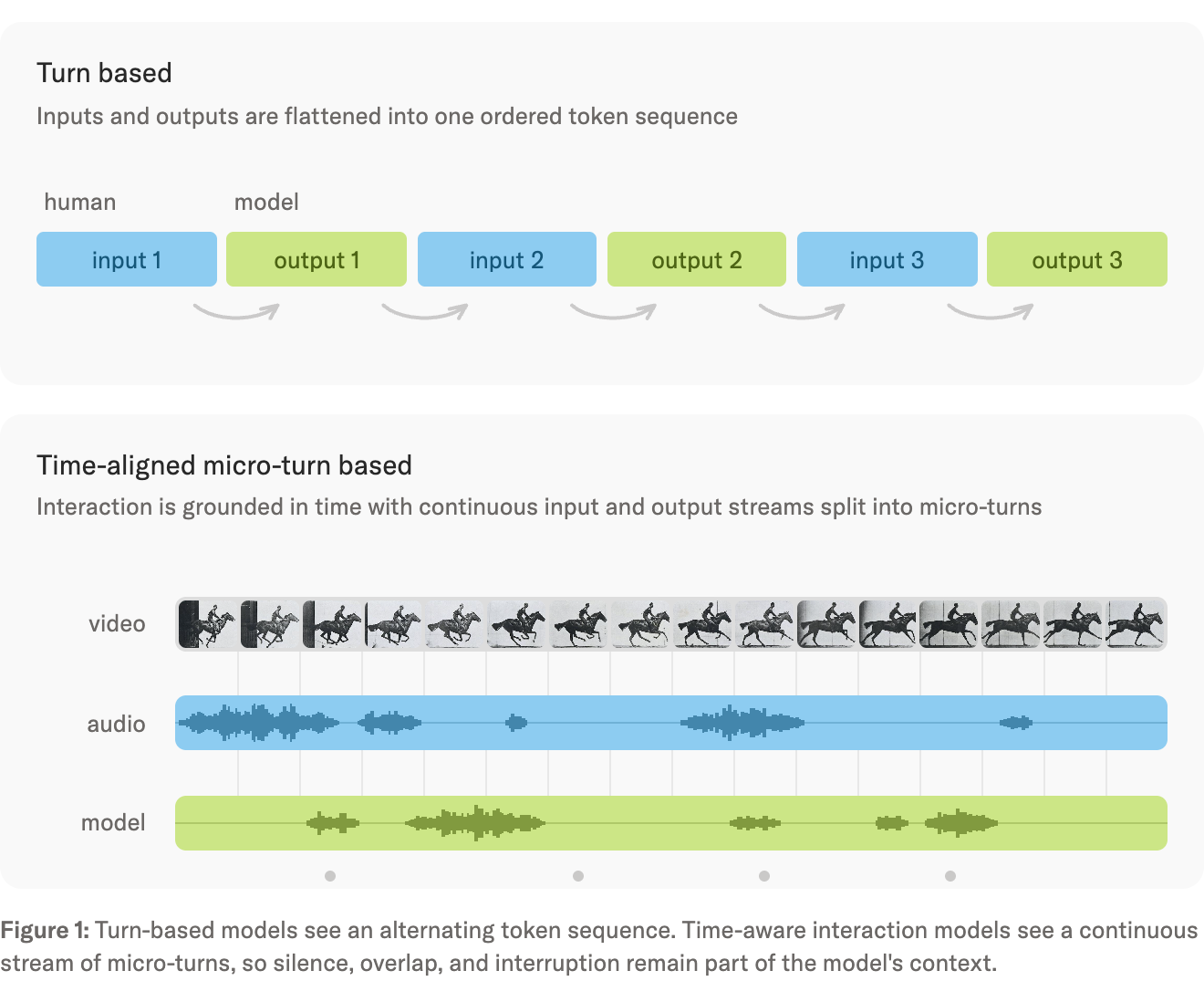
Turn-based models see an alternating token sequence. Time-aware interaction models see a continuous stream of micro-turns, so silence, overlap, and interruption remain part of the model’s context.
The direct sense of elapsed time is demonstrated in the time-awareness demo:
Figure — human perception vs. model token sequence (source Fig. 3)
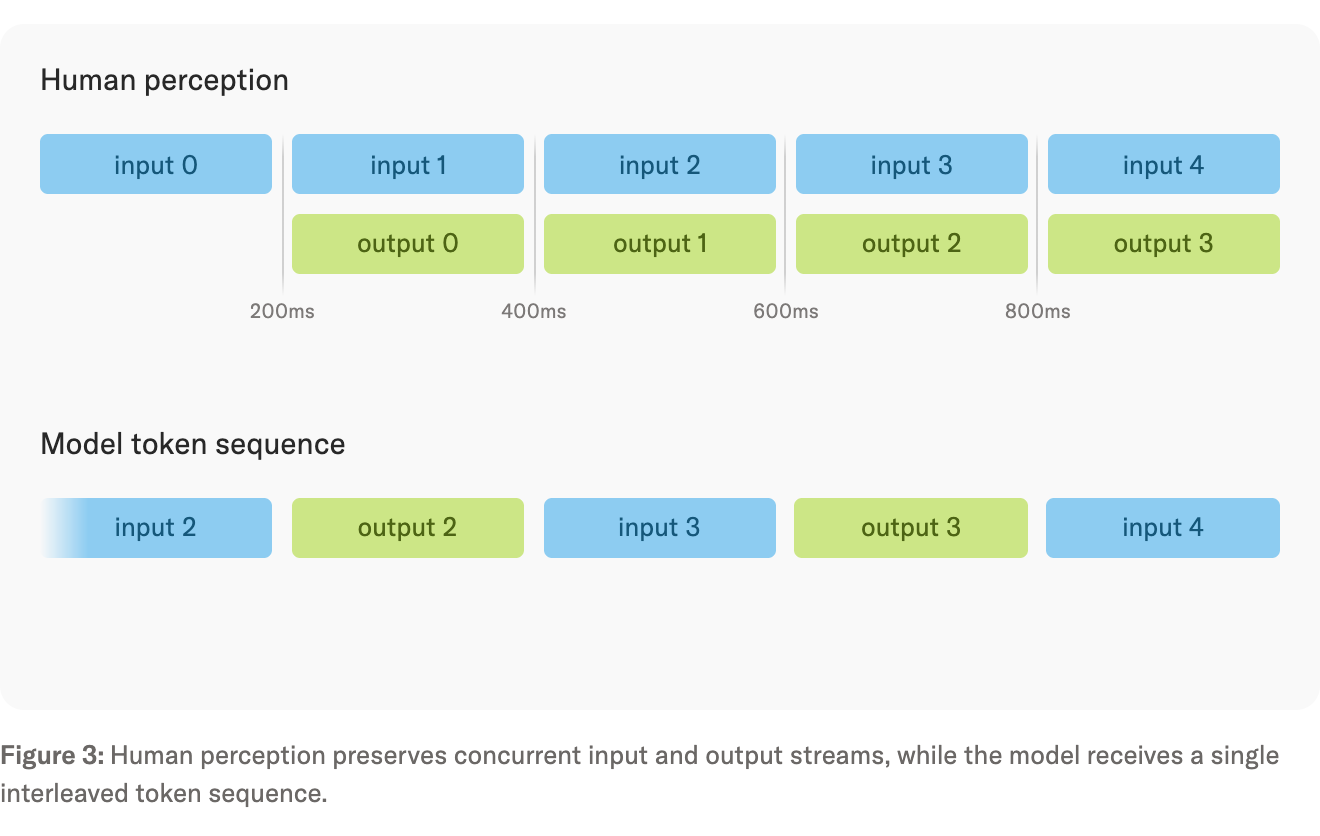
Human perception preserves concurrent input and output streams, while the model receives a single interleaved token sequence.
Why it matters
- No artificial turn boundaries the model must obey — silence, overlap, and interruption remain part of context.
- Removes the need for a turn-prediction harness (e.g. VAD) that is less intelligent than the model.
- Enables modes impossible for turn-based systems: proactive interjections (“interrupt when I say something wrong”), speaking while listening (live translation), and reacting to visual cues (“tell me when I’ve written a bug”).
- The model gains a direct sense of elapsed time (grounding for benchmarks like TimeSpeak / CueSpeak).
Inference cost
200ms chunks mean frequent small prefills/decodes under strict latency budgets — addressed via streaming sessions (chunks appended into a persistent GPU sequence, upstreamed to SGLang) and latency-tuned kernels. See TML-Interaction-Small.
Training data
TML doesn’t disclose how TML-small is trained on real-world data — see the training-data notes on TML-Interaction-Small (undisclosed) and the documented analogue on Moshi.
Compare: Moshi’s multi-stream tokens
Moshi solves the same “keep silence/overlap/interruption in context” problem in the audio domain via Multi-Stream Audio Modeling — two fixed-rate (12.5 Hz) parallel token streams over the Mimi codec, rather than interleaved 200 ms multimodal micro-turns. Same intent (Full-Duplex Spoken Dialogue), different granularity and modality coverage.
Source: Interaction Models (TML blog).