Figure — system overview (source Fig. 2)
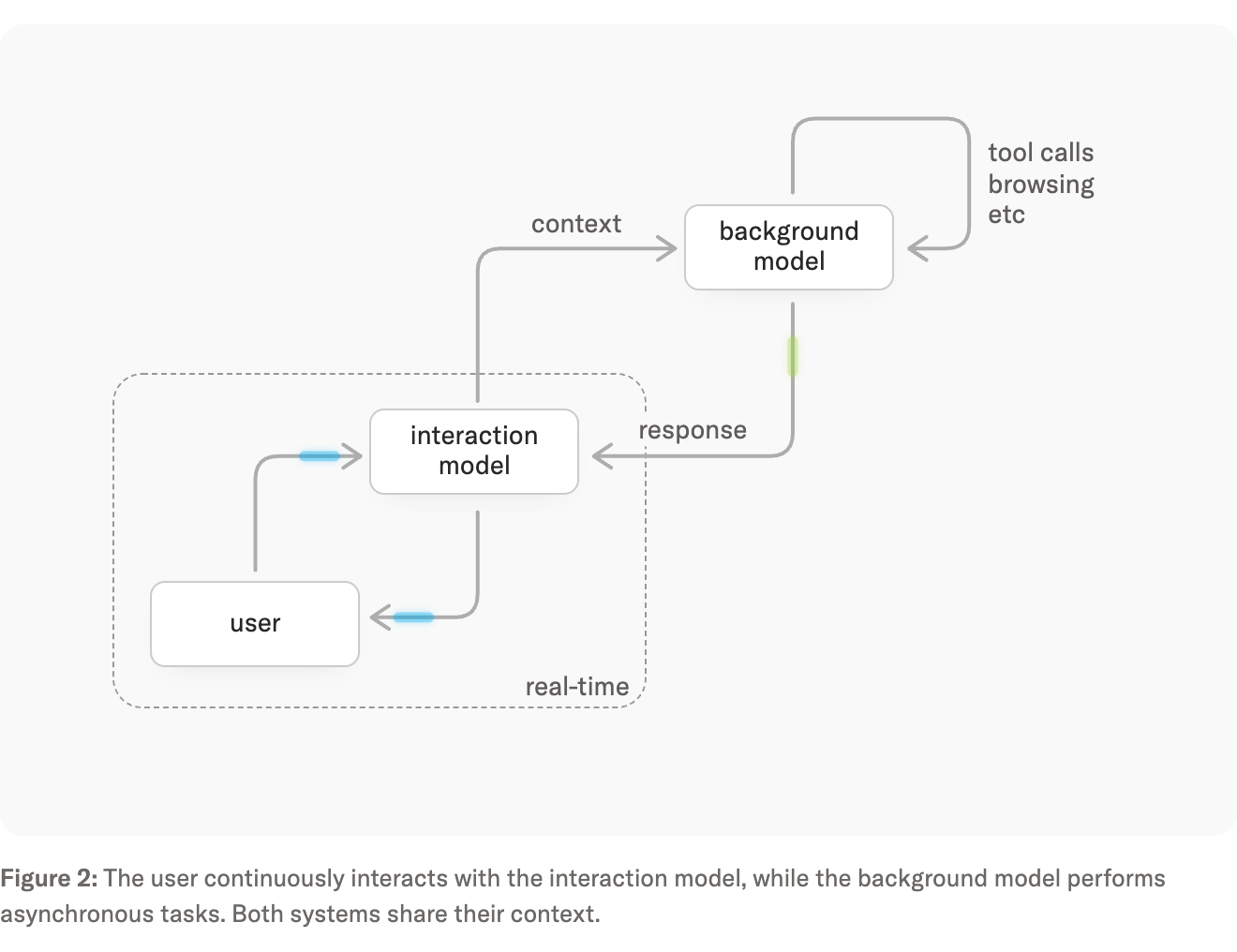
The user continuously interacts with the interaction model, while the background model performs asynchronous tasks. Both systems share their context.
The two-model system architecture used by TML-Interaction-Small:
- Interaction model — maintains real-time presence via Time-Aligned Micro-Turns; perceives and responds continuously.
- Background model — runs asynchronously for sustained reasoning, tool use, and longer-horizon agentic work.
When a task needs deeper reasoning than can be produced instantly, the interaction model delegates by sending a rich context package (the full conversation, not a standalone query). Results stream back and the interaction model interleaves them into the conversation at a moment appropriate to what the user is currently doing — avoiding an abrupt context switch. The interaction model stays present throughout (answering follow-ups, taking new input, holding the thread).
Payoff
Responsiveness of a non-thinking model and the planning/tool-use of a reasoning model. Both halves are independently intelligent — the interaction model alone is competitive on intelligence benchmarks.
Demos (from the source) — full catalog on Interaction Models (TML blog):
Simultaneous tool calls and search
Longer real session
Open questions
- How does this delegation compare to other agentic/orchestration architectures?
- The post calls the background agents “early-stage” — room for the two to cooperate more deeply.
Contrast: single-model full-duplex (Moshi)
Moshi is a counterpoint — a single streaming model with no background/reasoning split. It gets responsiveness from architecture (Multi-Stream Audio Modeling, a fast codec) rather than by offloading heavy reasoning. The split is TML’s bet for “thinking-model intelligence at non-thinking latency”; Moshi shows full-duplex is achievable without it (at lower reasoning depth). See Moshi (Kyutai paper).
Source: Interaction Models (TML blog).