The audio encoder of Qwen3-Omni — an attention-based encoder–decoder, auto-regressive model trained from scratch on 20 million hours of supervised audio. It replaces the Whisper encoder used in Qwen2.5-Omni (and in Voxtral) with a purpose-built, general-purpose audio representation. ~0.6B / 650M parameters. Source: Qwen3-Omni (technical report).
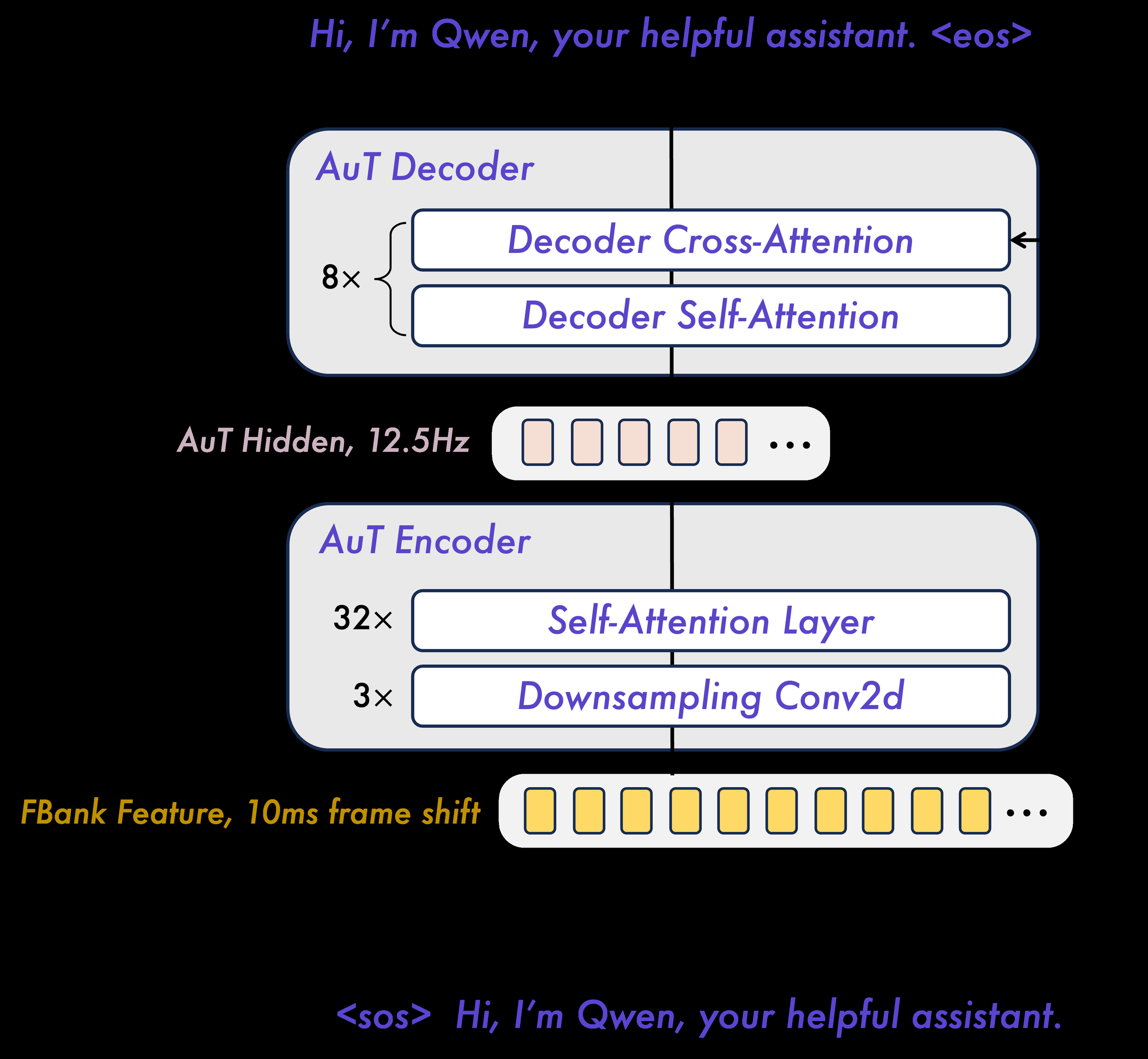
Figure 3 — AuT overview. An attention encoder–decoder auto-regressive model trained from scratch on 20M hours of supervised audio; Qwen3-Omni uses the encoder to obtain general-purpose audio representations at a 12.5 Hz token rate.
How it works
- Input: filter-bank / mel features → Conv2D blocks downsample 8× before the attention layers → token rate 12.5 Hz (~80 ms per frame). (In Qwen3-Omni the front end is a 128-channel mel-spectrogram at 16 kHz, 25 ms window / 10 ms hop.)
- Training tasks: speech recognition and audio understanding, for stronger and more general representations than ASR-only encoders. Data mix: 80% Chinese/English pseudo-labeled ASR · 10% other-language ASR · 10% audio understanding.
- Streaming trick — block-wise window attention: AuT uses flash attention with dynamic attention window sizes (query patterns from 1 to 8 seconds), balancing real-time prefill caching against performance on offline/long-audio tasks. This is what lets the encoder participate in ~234 ms end-to-end streaming.
- In Qwen3-Omni only the encoder is used (the decoder is a training-time device).
Why it’s notable
- From-scratch, supervised, 20M-hour encoder is a bet that a bespoke audio backbone beats adapting Whisper — a direct contrast with Voxtral, which keeps a Whisper large-v3 encoder + adapter for Speech Understanding.
- The 12.5 Hz output rate matches the codec rate used elsewhere in real-time speech systems (cf. Mimi (neural audio codec) in Moshi) — a convergent “one token ≈ 80 ms” design point that keeps decoder sequence lengths tractable for long audio and low latency.
See also
- Qwen3-Omni · Thinker-Talker Architecture
- Encoder contrast: Voxtral (Whisper-based) · rate contrast: Mimi (neural audio codec)