Technical report (arXiv 2509.17765, Sept 2025) for Qwen3-Omni, Qwen Team’s natively end-to-end omni-modal model — text, image, audio, and video in, streaming text or speech out.
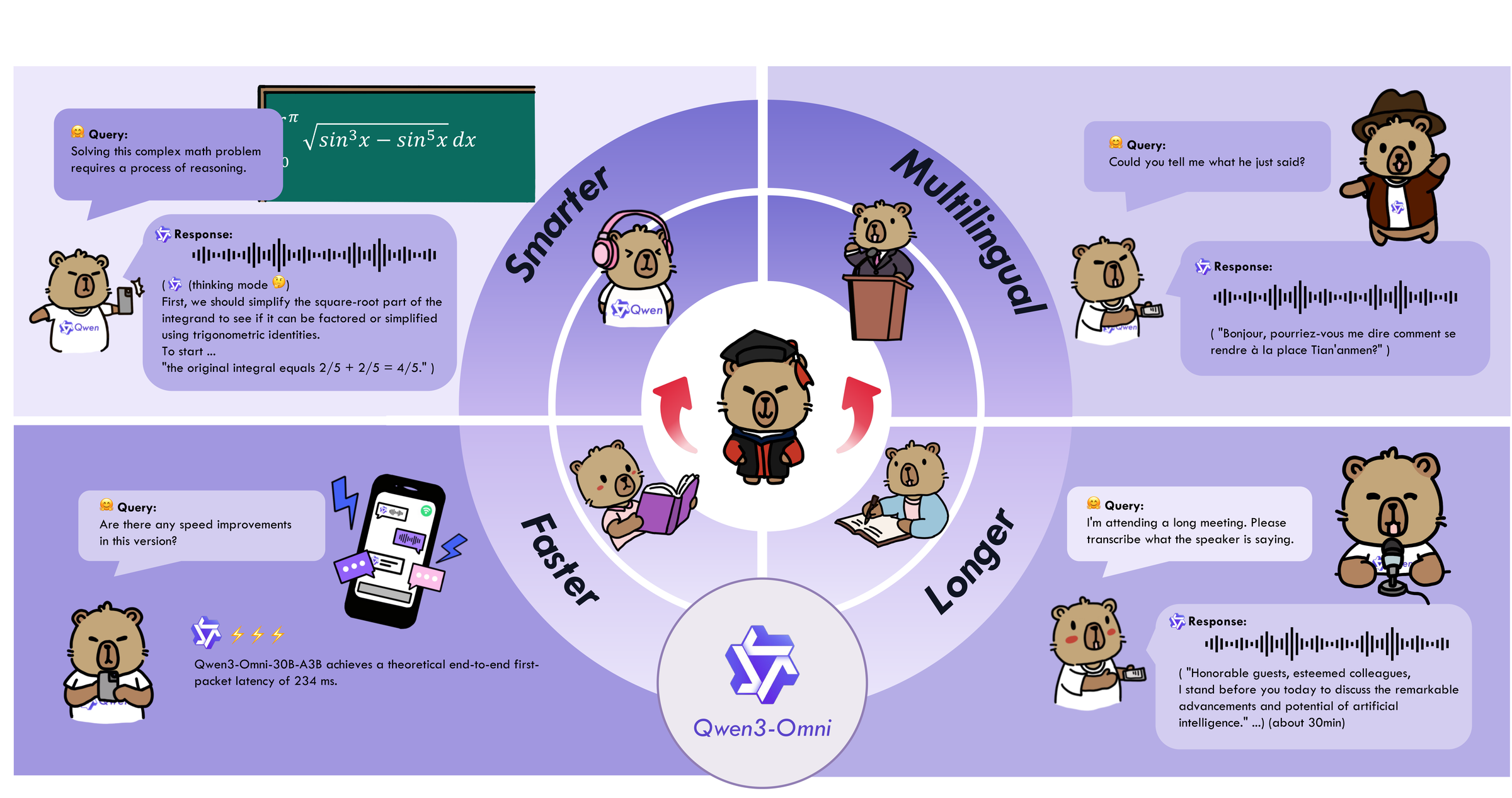
Figure 1 — Qwen3-Omni is a unified end-to-end model over text, audio, image and video that generates real-time text or speech; it supports voice dialogue, video dialogue, and video reasoning.
Why it matters here
Qwen3-Omni is a fourth data point for Real-Time Interactive Speech Models, and the first that is omni-modal rather than speech-centric. Its headline claim is non-degradation: joint multimodal training reaches parity with same-size unimodal Qwen models on text and vision while adding strong audio — refuting the usual “modality tax.” For this wiki’s audio lens, three contributions matter:
- AuT (Audio Transformer) — a from-scratch audio encoder (20M hours) that replaces Whisper, emitting general-purpose audio tokens at 12.5 Hz with block-wise window attention for real-time prefill caching.
- Thinker-Talker Architecture — a text-generating Thinker + a speech-token-generating Talker, both upgraded to MoE, with the Talker producing multi-codebook RVQ speech and a lightweight Code2Wav ConvNet vocoder for single-frame synthesis.
- Streaming: end-to-end first-packet latency as low as 234 ms (audio) / 547 ms (audio-video).
Audio takeaways
- Scale/results: across 36 audio & audio-visual benchmarks, open-source SOTA on 32 and overall SOTA on 22, beating Gemini 2.5 Pro, Seed-ASR, and GPT-4o-Transcribe on parts.
- Long audio: understands inputs > 40 minutes.
- Languages: 119 written; 19 spoken languages for understanding, 10 for generation.
- Thinking model: a reasoning variant covers full-modality (audio-only and audio-video) reasoning.
- Sizes (Qwen3-Omni-30B-A3B): AuT audio encoder 650M · SigLIP2 vision encoder 540M · Thinker MoE 30B-A3B · Talker MoE 3B-A0.3B · MTP 80M · Code2Wav ConvNet 200M.
Relation to existing sources
- vs Moshi — both are real-time speech-capable and both generate speech from RVQ codec tokens, but Moshi is a single-stream-per-speaker Multi-Stream Audio Modeling system with Inner Monologue, while Qwen3-Omni splits generation into Thinker-Talker Architecture (text model + speech model). See the comparison on Real-Time Interactive Speech Models.
- vs Voxtral — Voxtral is audio-understanding only (Speech Understanding, audio→text). Qwen3-Omni both understands (its AuT encoder path is the analog of Voxtral’s Whisper+adapter) and generates speech.
- Both Qwen3-Omni and Moshi drive a 12.5 Hz codec rate — a recurring number for real-time speech token modeling (cf. Mimi (neural audio codec)).
Open threads
- How does AuT’s supervised-from-scratch encoder compare head-to-head with Whisper-based encoders (Voxtral) on understanding?
- Talker conditions on Thinker’s multimodal features but not its text representations — what does decoupling cost/buy vs Moshi’s text-audio Inner Monologue?
- Multi-codebook RVQ + MTP + ConvNet vocoder vs Moshi’s RQ-Transformer Depth Transformer — which streaming speech-generation stack wins on latency/quality?